Calvin and Wakely’s correspondence
Lessons in ChemistryCalvin and Wakely’s correspondence is an archive of typed exchanges between Calvin Evans and Reverend Wakely, two men who never met face-to-face while they were writing. Read years later by Elizabeth Zott, the letters recover a lively intellectual friendship and expose a final outburst about Calvin’s father that neither she nor the reader can readily explain. Their significance lies in that tension: the pages preserve Calvin’s brisk certainty, but also leave the deepest source of his anger unresolved.
The archive and its discovery
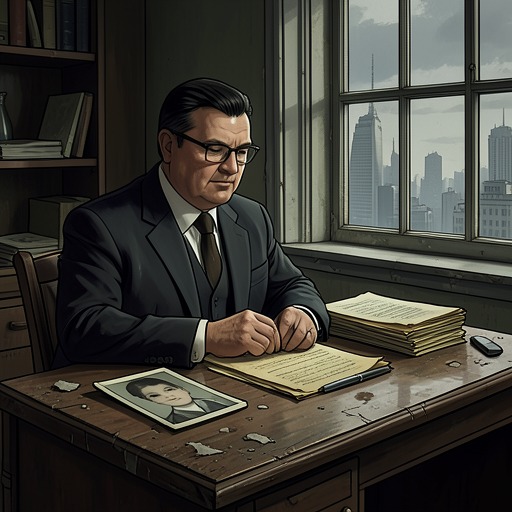
Elizabeth finds the correspondence in a folder labeled “Wakely.” It contains numerous typed letters between Calvin and a would-be theologian, along with carbon copies of Calvin’s replies. The copies are characteristic of Calvin, who kept copies of everything; they also make his side of the exchange available alongside Reverend Wakely’s, rather than leaving the conversation to be reconstructed from one correspondent’s account.
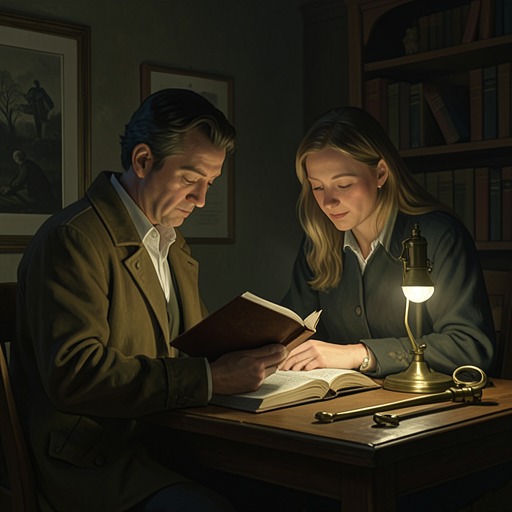
The letters reach Elizabeth while she is trying to understand Calvin’s past and explain it to Madeline Zott. She reads the exchanges as evidence of a connection formed at a distance: the men had never met in person, yet their correspondence ranges across belief, scientific work, family expectations, and rowing. The archive is therefore both an intimate record and an incomplete one. It preserves what they chose to write, but the surviving final exchange gives no account of why they stopped.
Science, faith, and a point of connection
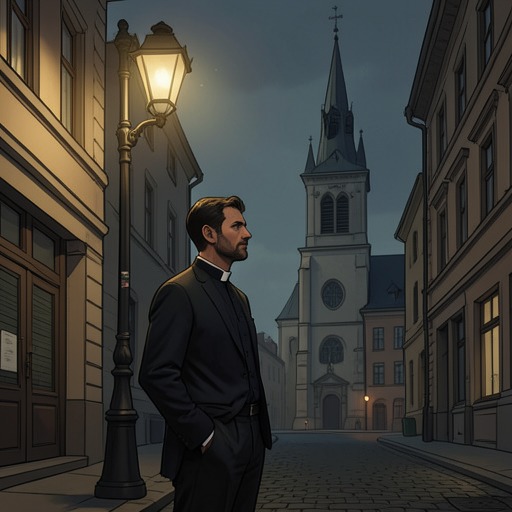
Reverend Wakely’s first letter follows a brief appearance by Calvin at a science symposium in Boston. Wakely, then studying at Harvard Divinity School while Calvin was at Cambridge, had read Calvin’s article “The Spontaneous Generation of Complex Organic Molecules.” He writes to ask whether it is possible to believe in both God and science. Calvin answers, “It’s called intellectual dishonesty.” His reply is deliberately flippant, but Reverend Wakely is not deterred; he responds with an analogy between chemistry and painting, arguing that each implies a creator.
Calvin dismisses the analogy with the blunt declaration, “I deal in evidence-based truths, not conjecture,” then rejects Wakely’s “master chemist theory.” The exchange establishes a real difference in their premises: Wakely is trying to reconcile religious belief with scientific inquiry, while Calvin insists on evidence and treats the proposed reconciliation as unsupported. Yet disagreement does not end the conversation. Calvin notices that Wakely is at Harvard and asks whether he rows, mentioning his own rowing for Cambridge on a full-ride scholarship.
Wakely replies that he is not a rower but loves the water and is a surfer who grew up in Commons, California. He recommends the place and notes that people row there too. Much later, Elizabeth connects this detail to Calvin’s marked interest in the California return address on an offer from Dr. Donatti. The correspondence helps her understand that Calvin accepted the insulting offer not simply for the professional opportunity: Commons had become personally meaningful to him through Wakely’s letters. That connection does not make Calvin’s decision wise in Elizabeth’s eyes, but it gives the choice a human motive beyond career calculation.
The last exchange and its silence
The letters also show Reverend Wakely wondering whether inherited family expectations have shaped his life. He writes that the Wakelys become ministers much as cobblers’ sons become shoemakers, admits that he has always been attracted to biology, and suggests that he may be trying to please his father. He asks Calvin whether his father was a scientist and whether Calvin, too, was trying to please him.
Calvin’s answer, typed in capital letters, breaks sharply with the rest of the archive: “I HATE MY FATHER,” followed by “I HOPE HE’S DEAD.” Elizabeth is stunned when she reads it. Calvin’s father had been dead for at least two decades, killed by a train, so the wish cannot be explained as a literal hope that he might die in the future. The surviving evidence does not settle what Calvin meant, why he expressed himself this way, or why the correspondence ended. Its final letter is dated nearly ten years before Elizabeth finds it. The abrupt ending makes the papers more than a record of a disagreement: they preserve a rupture whose cause remains outside the archive.
What the letters leave behind
The correspondence offers Madeline Zott a route into her father’s history, but not a complete portrait. Elizabeth withholds her own interpretation of Calvin’s choice to accept Dr. Donatti’s offer because she wants Madeline to think of her father as rational; the letters complicate that wish by revealing both the emotional pull of Commons and the anger Calvin kept in reserve. They let Madeline encounter his words, while leaving her without a final explanation for them.
Later, Reverend Wakely is present in a family photograph Madeline brings to him: a clipping from Calvin’s funeral, in which Elizabeth and Six-Thirty watch the burial, with Madeline inside Elizabeth and Calvin in the casket. Madeline’s way of defining the family challenges a strictly genealogical account, and Reverend Wakely tells her that people belong to the animal kingdom, not the plant kingdom. The surviving evidence does not establish that the letters caused their later closeness. Their juxtaposition nevertheless gives the correspondence a wider resonance: a friendship that began in argument and typed pages becomes part of a story in which family is understood through care, memory, and belonging as well as ancestry. The letters cannot answer every question about Calvin, but their combination of sharp wit, shared interests, and unresolved pain keeps him present to those who never had the chance to meet him.